Did you know that 93% of Canadian adults have experienced permanent tooth decay at some point in their lives? Understanding the progressive stages of tooth decay is essential for managing this common concern, yet many people only realize there is a problem when they feel a sharp twinge of sensitivity or persistent discomfort. It is natural to feel anxious about the potential cost of restorations or the prospect of a dental procedure, but catching these changes early can make a significant difference in your long-term comfort.
The good news is that tooth decay is a biological process that can often be stopped or even reversed before it ever requires a drill. This guide will provide the clarity you need to recognize how decay moves through five critical phases and explain the modern, patient-centric strategies used to protect your smile. We will explore everything from initial mineral loss to advanced infections, giving you the confidence to seek professional help at our Red Deer clinic at the most effective time for your health and peace of mind.
Key Takeaways
- Learn how to identify the earliest signs of enamel weakening, where professional remineralization can often reverse the process before a physical cavity forms.
- Understand the progression through the five stages of tooth decay so you can recognize the difference between minor sensitivity and a dental emergency.
- Discover how personal factors like dry mouth and tooth alignment create hidden risks and how to effectively manage these vulnerable areas.
- Master the 2026 Canadian gold standard for daily hygiene to prevent decay between teeth and maintain your smile’s natural strength.
- Explore modern restorative options, including tooth-coloured composite fillings and crowns, that restore both function and aesthetics with a focus on your comfort.
The Science of Tooth Decay: How Cavities Actually Form
Tooth decay is often misunderstood as a simple hole that appears out of nowhere; however, it is actually a progressive bacterial infection that changes the very chemistry of your smile. When dental professionals discuss the stages of tooth decay, they are referring to the ongoing demineralization of your tooth’s protective layers. Your mouth is a dynamic environment where a constant tug-of-war takes place between minerals leaving and entering the enamel surface. Every time you eat, acids can pull minerals out. Conversely, every time you rest or hydrate, your saliva attempts to push those minerals back in. Understanding this delicate balance is the first step toward taking control of your oral health.
To visualize how decay moves, you have to understand the three distinct layers of a tooth. The enamel is the hard, mineralized outer shell designed to withstand the pressure of chewing. Beneath that lies the dentin, a softer, yellowish layer that contains microscopic tubules leading to the tooth’s core. At the very centre is the pulp, which houses the nerves and blood vessels that keep the tooth alive. For a comprehensive overview of tooth decay, it is vital to see these layers as a series of defences that the infection must breach. When the balance shifts and minerals are lost faster than they are replaced, the structure begins to fail.
The Role of Plaque and Biofilm
Plaque is not just “food debris” that can be rinsed away with water. It is a sophisticated, living biofilm that clings stubbornly to your teeth. When you consume sugary or starchy foods, the bacteria within this biofilm convert those carbohydrates into enamel-eroding acid. This process causes the pH level in your mouth to drop. When your oral environment becomes too acidic, your enamel literally begins to dissolve. If plaque isn’t removed through diligent brushing, it hardens into tartar, also known as calculus. This stony substance acts as a protective shield, allowing bacteria to thrive and tunnel deeper into the tooth structure where your toothbrush can’t reach.
Remineralization: The Stage Where Decay Can Stop
Many people don’t realize that the very first of the stages of tooth decay is actually reversible. These “pre-cavities” often appear as chalky white spot lesions on the surface of the tooth, indicating that the enamel has been weakened. At this point, the enamel has lost minerals but hasn’t yet collapsed into a physical hole. Your saliva is your natural defence, carrying calcium and phosphate to the site of the damage to help strengthen the area. In Red Deer, our municipal water is fluoridated, which provides an extra layer of protection by making your enamel more resistant to acid attacks. Remineralization is the process of restoring calcium and phosphate to the enamel. By using fluoride treatments and maintaining a neutral pH, you can effectively heal the tooth before it requires a physical restoration.
The 5 Critical Stages of Tooth Decay Progression
Understanding how a tooth breaks down helps you take action before a minor issue becomes a major expense. The stages of tooth decay move from invisible chemical changes to structural damage that can impact your overall health. By recognizing these milestones, you can better communicate with your dental team and choose the least invasive treatment possible. We believe that knowledge is the best tool for reducing dental anxiety, as it removes the mystery from your diagnosis.
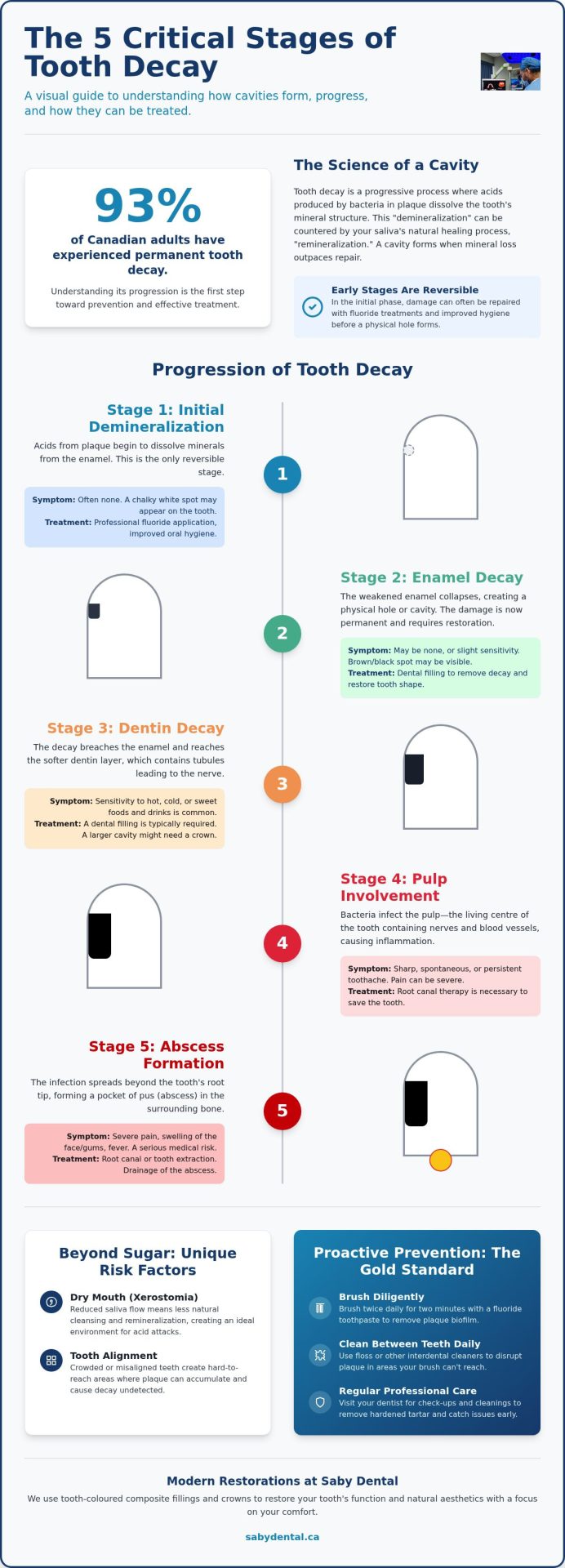
- Stage 1: Initial Demineralization. This is the only reversible phase, often appearing as chalky white spots where the enamel has lost its mineral density.
- Stage 2: Enamel Decay. Once the surface minerals are gone, a physical hole or cavity forms. At this point, the decay has broken through the hardest layer of the tooth.
- Stage 3: Dentin Decay. The infection reaches the softer layer beneath the enamel. Because dentin connects to the tooth’s nerves, this is usually when sensitivity to cold or sweets begins.
- Stage 4: Pulp Involvement. The decay enters the pulp centre, which contains the blood vessels and nerves. This often results in significant inflammation and persistent pain.
- Stage 5: Abscess Formation. The infection travels through the root tip and into the surrounding bone, creating a pocket of pus that can cause severe facial swelling.
Visual Signs and Symptoms to Watch For
You might notice a small white spot on your tooth that doesn’t brush away; this is your first warning sign. As the stages of tooth decay advance, these spots often turn light brown, dark brown, or even black, indicating that the structure is softening. It is important to remember that some cavities are completely invisible to the naked eye, especially when they form between teeth. Digital X-rays are essential for spotting these “interproximal” cavities before they reach the dentin. Following consistent Cavity prevention tips can help you catch these signs early. If you haven’t had a professional look at your smile in the last six months, a routine dental exam is a gentle way to ensure everything is healthy.
Advanced Complications: Gum Boils and Swelling
When decay reaches the final stage, the body attempts to wall off the infection, which can lead to a “gum boil.” This looks like a small pimple on the gums near the root of the tooth and is a clear signal that an abscess has formed. This stage often brings a persistent, throbbing ache that can radiate to the jaw or ear. If you notice facial swelling, a fever, or a bitter taste in your mouth, the infection may be moving beyond the tooth. This situation requires immediate care from an emergency dentist in Red Deer to prevent the infection from spreading further into the body.
Beyond Sugar: Understanding Your Unique Risk Factors
While diet is a major factor, your biology and lifestyle play equally significant roles in how quickly you might progress through the stages of tooth decay. One of the most overlooked risks is Xerostomia, or chronic dry mouth. Saliva is your mouth’s natural cleaning agent; it neutralizes acids and provides the minerals needed for remineralization. When saliva flow is reduced, often due to medications like antihistamines or blood pressure treatments, your teeth lose their primary line of defence. This creates an environment where bacteria can thrive, accelerating the breakdown of enamel at an alarming rate.
Tooth alignment also dictates your risk profile. When teeth are crowded or rotated, they create “plaque traps” that are nearly impossible to clean with a standard toothbrush or even traditional floss. These hidden areas allow biofilm to mature and cause decay between teeth long before you notice any symptoms. Additionally, while many people believe they simply have “soft teeth,” the reality is usually tied to enamel thickness or the presence of microscopic defects. Genetics do play a role, but your daily habits and environment are far more influential in determining how your teeth stand up to acid attacks.
The Connection Between Teeth Wear and Decay
Physical wear can be just as damaging as chemical erosion. If you struggle with bruxism, which is the habitual grinding or clenching of teeth, you are physically thinning your enamel every night. This mechanical wear makes it much easier for acids to penetrate the tooth. Clenching also creates micro-cracks in the enamel. These tiny fissures act as highways for bacteria to reach the sensitive dentin layer. Addressing these functional issues through TMJ treatment can protect your smile from structural damage and significantly reduce your overall cavity risk.
Environmental Factors in Red Deer
Living in Central Alberta presents specific challenges for your oral health. Our local climate is notably dry, which often leads to mouth breathing during sleep or while exercising outdoors. This habit dries out oral tissues and reduces the protective benefits of saliva overnight. On a positive note, Red Deer currently maintains municipal water fluoridation, which is a vital community health measure that helps strengthen enamel for residents of all ages. However, the local “coffee culture” can counteract these benefits. It is often the frequency of acidic sips, rather than the total quantity, that keeps your oral pH in a danger zone. Consuming your morning coffee in one sitting is far better for your teeth than sipping it over several hours, as it allows your saliva time to recover and protect your enamel.
Proactive Prevention: Protecting Your Smile in Red Deer
To stay ahead of the various stages of tooth decay, you need a daily routine that reflects the latest Canadian dental standards. In 2026, the gold standard for home care involves brushing for two full minutes twice a day with a soft-bristled brush and fluoride toothpaste. While brushing cleans the visible surfaces, flossing is the only way to disrupt the biofilm hiding between your teeth. This is where “interproximal” decay often begins, quietly tunneling through the enamel where your brush cannot reach. Regular professional cleanings are equally vital because they remove tartar, the hardened plaque that your toothbrush simply cannot budge. By visiting a dental care centre near you, you ensure that these bacterial strongholds are cleared away before they can trigger deeper damage.
Professional intervention is your best defence against the progression of decay. During a routine exam, we use high-definition imaging to spot mineral loss at its earliest, reversible phase. This proactive approach allows us to apply non-invasive treatments that strengthen your teeth without the need for traditional restorations. Our goal is always to preserve as much of your natural tooth structure as possible, ensuring long-term stability and comfort for your smile.
The Role of Professional Fluoride and Sealants
Dental sealants provide a powerful physical barrier for the deep grooves and pits of your molars, which are often the most difficult areas to keep clean. These thin, protective coatings act like a shield, preventing food particles and bacteria from settling into vulnerable crevices. While over-the-counter rinses provide some benefit, professional fluoride varnish is significantly more effective because it is highly concentrated and designed to adhere to the tooth surface for several hours. This prolonged contact allows for deeper mineral absorption. Your gum health is also intrinsically linked to the longevity of your teeth; learning how to stop gum bleeding is a critical step in maintaining the structural integrity of your smile.
Nutritional Strategies for Stronger Teeth
What you eat directly influences your mouth’s ability to recover from acid attacks. Mineral-rich foods like cheese, yogurt, and leafy greens provide the calcium and phosphate your saliva needs to aid remineralization. We also recommend using Xylitol gum after meals. Xylitol is a natural sweetener that bacteria cannot digest, which effectively starves the decay-causing organisms in your mouth and helps neutralize acids. If you do consume an acidic beverage like coffee or a sports drink, try “buffering” the meal by rinsing with plain water immediately afterward. This simple habit helps return your oral pH to a safe level quickly, protecting your enamel from prolonged exposure. If you are ready to take the next step in your preventive care, we invite you to book a professional cleaning with our dedicated hygiene team.
Restoring Your Dental Health: Modern Treatments at Saby Dental
When a tooth has progressed through the later stages of tooth decay, modern dentistry offers solutions that are as beautiful as they are functional. At Saby Dental, we utilize tooth-coloured composite fillings to restore small to medium cavities. These materials bond directly to your natural tooth structure, which allows us to be more conservative with our preparations and provide a seamless, aesthetic result. If the decay has advanced to the point where the tooth is structurally compromised, a dental crown may be necessary to provide the strength needed for daily chewing. Dr. Jas Sandhu and our team bring over 30 years of expertise to every case, ensuring your treatment is handled with a steady, calming presence that prioritizes your comfort.
Precision is the cornerstone of our restorative philosophy. We rely on digital X-rays to catch decay at its most treatable stage, often before you feel any physical symptoms. These high-resolution images allow us to see exactly how far the demineralization has spread, ensuring that our treatment plan is both accurate and minimally invasive. By identifying issues early, we can often avoid more complex procedures, saving you both time and anxiety. Our family-run practice is dedicated to providing a supportive environment where you feel heard and cared for throughout your dental journey.
Precision Restorations and Smile Makeovers
For patients who have experienced significant damage, a comprehensive smile makeover can restore both health and confidence. Treating active decay is always the essential first step in any cosmetic plan, as a beautiful smile must be built on a healthy foundation. Once your teeth are stable, porcelain veneers can be used to mask previous damage and create a uniform, radiant appearance. For more complex restorative cases, we utilize X-Guide 3D navigation. This advanced technology allows for incredible precision when placing restorations, ensuring that your new smile is perfectly aligned with your unique facial features and bite mechanics.
Emergency Care for Advanced Decay
If a decayed tooth suddenly cracks or begins to cause a persistent, throbbing ache, the infection has likely reached the inner pulp. This is considered an advanced stage of the stages of tooth decay and requires prompt attention to save the tooth. Root canal therapy is a highly effective way to treat stage 4 decay by removing the infected tissue and sealing the tooth from further bacterial invasion. While the word “root canal” can cause some patients to feel uneasy, our gentle approach and modern anaesthetics ensure the process is no more uncomfortable than a standard filling. We always encourage our Red Deer neighbours to book a preventive exam today; catching a “watch” area now is the best way to prevent a painful dental emergency tomorrow.
Empowering Your Smile Through Knowledge and Care
Understanding the stages of tooth decay is the first step toward a lifetime of healthy, confident smiles. You now know that decay isn’t a sudden event but a dynamic process that we can often halt or even reverse with the right professional intervention. By recognizing the early signs of demineralization and addressing unique risk factors like dry mouth or teeth wear, you can protect your natural tooth structure and avoid the anxiety of more complex restorations.
At Saby Dental, we’ve provided our neighbours with over 30 years of clinical excellence in Red Deer. Dr. Jas Sandhu and our dedicated team offer a patient-centric environment where modern technology meets genuine warmth. From routine exams that catch issues at their most treatable phase to advanced X-Guide 3D navigation for precision results, we’re here to ensure your comfort and peace of mind. Every smile is unique, and we take the time to listen to your concerns and provide the personalized attention you deserve.
Don’t wait for a minor sensitivity to become a painful emergency. Book your comprehensive dental exam at Saby Dental today to ensure your smile remains strong and healthy for years to come. We look forward to welcoming you into our practice soon.
Frequently Asked Questions
Can tooth decay be reversed without a filling?
Yes, tooth decay can be reversed during the very first stage, known as initial demineralization. At this point, your enamel has lost minerals but hasn’t yet collapsed into a physical hole. By using professional fluoride treatments and maintaining excellent oral hygiene, you can help minerals return to the tooth surface. This process strengthens the weakened area and stops the infection before it requires a traditional restoration.
How long does it take for a cavity to form?
The timeline for a cavity to develop varies significantly between individuals, typically ranging from several months to a few years. Factors such as your diet, the thickness of your enamel, and the frequency of your hygiene sessions all play a role in this progression. If you consume a high-sugar diet or suffer from dry mouth, you may move through the stages of tooth decay much faster than someone with healthy saliva flow.
Why does my tooth hurt when I eat something cold or sweet?
This discomfort usually indicates that decay has reached the dentin, which is the sensitive layer beneath your enamel. Dentin contains microscopic tubules that lead directly to the tooth’s nerve centre. When you consume something cold or sweet, these tubules transmit the sensation to the nerve, causing a sharp twinge. This is a clear sign that the decay has progressed to Stage 3 and requires professional attention to prevent further damage.
Is it possible to have a cavity and not know it?
Yes, it’s very common to have a cavity without experiencing any pain or visible symptoms. Your outer enamel doesn’t contain nerves, so decay can grow silently until it reaches the more sensitive dentin or pulp layers. This is why regular digital X-rays are so important; they allow us to see between your teeth and under the surface to catch issues before they become painful emergencies.
Are some people naturally more prone to tooth decay than others?
Some individuals are more susceptible to cavities due to genetic factors like the shape of their teeth or the composition of their saliva. Deep grooves in your molars can act as plaque traps that are difficult to clean, while a lower saliva pH can make your enamel more vulnerable to acid. However, even if you’re naturally prone to decay, a customized preventive plan can help you maintain a healthy smile.
What is the difference between a cavity and a stain?
A stain is a surface discoloration often caused by coffee, tea, or tobacco, whereas a cavity is a permanent hole caused by bacterial infection. During an exam, we check the texture of the area; stains are usually hard and smooth, while a cavity feels soft or sticky to a dental probe. While a stain is purely an aesthetic concern, a cavity will continue to grow and damage the tooth structure if left untreated.
How often should I have a dental exam to prevent cavities?
Most patients should have a professional exam and cleaning every six months to effectively prevent decay. This frequency allows us to monitor your oral health and catch any mineral loss at its reversible stage. If you have a history of rapid decay or certain medical conditions that cause dry mouth, we might recommend more frequent visits to keep your smile on track and minimize the need for complex restorations.
Do children get cavities faster than adults?
Children’s primary teeth have thinner enamel than adult permanent teeth, which allows decay to spread much more quickly. Because the layers are thinner, the infection can reach the nerve in a shorter amount of time. It’s essential to monitor a child’s progress through the stages of tooth decay closely to ensure their primary teeth remain healthy until they are ready to fall out naturally.